

To be honest I am much more comfortable describing the future of a brand or business than my own future. Despite this I took the challenge of visualising my future ‘best possible self’ late last year. Writing for just over 2 hours I responded to the instructions used by Laura King in her 2001 study, which were:
Think about your life in the future. Imagine that everything has gone as well as it possibly could. You have worked hard and succeeded at accomplishing all of your life goals. Think of this as the realisation of all of your life dreams.
For me it was a positive exercise that made long-term aims more tangible and has informed my 2025 plans. Prompted by my experience I explored the academic research which links this activity to some impressive benefits which are worthy of sharing.
In 2001 King’s original quant study found best possible self (BPS) writing to be associated with improved mood (measured as positive affect), increased satisfaction with life and a reduction in illness-triggered visits to health centres. More than 30 following studies have reaffirmed optimism and happiness boosting benefits. It seems simply completing the writing exercise enhances well-being and optimism for most people.
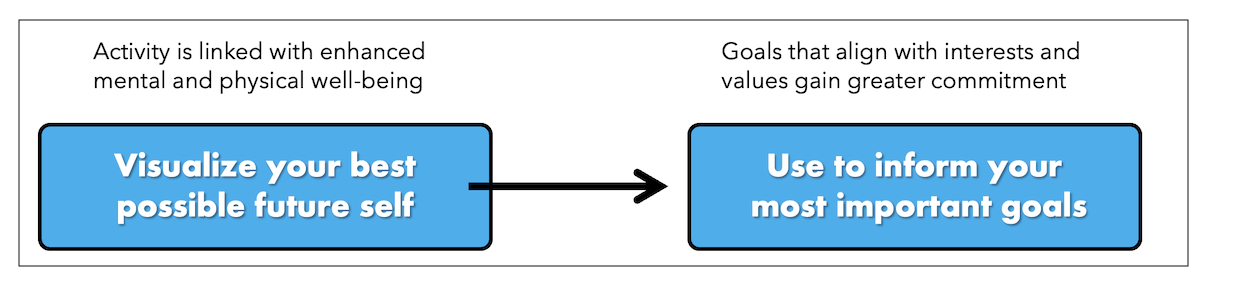
Qualitative studies have also indicated that visualising your future BPS facilitates commitment to self-improving goals. In building an understanding of what is important and where we want to be it supports the development of self-concordant goals – i.e. goals that fit with personal interests and values. BPS writing has consequently been championed as a tool to drive individual preventative healthcare action.
BPS articulation also provides an ongoing reference for developing and adjusting goals to address what matters and motivates us most. In both increasing optimism and sharpening focus it can therefore play a part in building the resilience and perseverance that supports skill mastery, career success and more.
I hope my belated discovery of the BPS exercise did prove worthy of sharing. For anyone now tempted to find 2-3 hours for meeting their best possible self in 2025 I have captured some guidance below this article. It aggregates design elements found to drive positive results from multiple studies.
Whatever your plans I wish you the very best possible 2025…
Key sources for this article include:
Laura King’s Research: King, L. A. (2001). The Health Benefits of Writing About Life Goals. Personality and Social Psychology Bulletin, 27, 798–807. DOI:10.1177/0146167201277003
Results of more than 30 studies: Loveday, P. M., Lovell, G. P. and Jones, C. M. (2018). The Best Possible Selves Intervention: A Review of the Literature to Evaluate Efficacy and Guide Future Research. Journal of Happiness Studies, vol. 19(2), 607-628. https://doi.org/10.1007/s10902-016-9824-z
Linking BPS to concordant goal setting: Round, J. and Burke, J. (2018). The longitudinal experiences and perceived retirement wellbeing of recent retirees following a tailored intervention linking best possible self-expressive writing with goal-setting. International Coaching Psychology Review Vol 13 No 2. https://www.researchgate.net/publication/336261342
Perseverance and mastery: Duckworth, A. (2016). Grit: The power of passion and perseverance. Scribner/Simon & Schuster.
BEST POSSIBLE FUTURE SELF GUIDANCE
VISUALISING INSTRUCTIONS
1. Commit to 15-20 minutes of writing for 3 days each week for three consecutive weeks to develop your visualisation1. Read and imagine your description after each writing period 2. If you feel your visualisation is comprehensive and complete you can stop writing – read your visualisation in remaining time and consider actions that flow from it.
2. Think about your life in the future. Imagine that everything has gone as well as it possibly could. You have worked hard and succeeded at accomplishing all of your life goals. Think of this as the realisation of all of your life dreams. 3
3. Address all areas that are important for you such as: family life, future learning, hobbies or personal interests, career situation, social life, relationship with partner, community involvement, and physical/mental health. It may help to pick 1-3 areas to address in each burst. 4
4. Think about making the most of existing strengths and skills. You can identify character strengths before starting at https://www.viacharacter.org/ 4
REFERENCING AND REFLECTING
Use your BPS for inspiration and direction. It can inform what is most important and motivating to you and so help in terms of establishing long-term goals and / or short-term actions to address an area for growth. We are better able to persevere on what we are passionate about. 5
You can’t do everything or always succeed. Seek to increase the share of your time and effort for activities that support what is most important. Retain the flexibility to embrace alternative pathways when things don’t work out or opportunities emerge.
- Extended writing duration has been found to increase benefits. Sheldon, K. M. and Lyubomirsky, S. (2006). How to increase and sustain positive emotion: The effects of expressing gratitude and visualizing best possible selves.
- Engagement with BPS imagery has been shown to increase optimism. Meevissen, Y. M. C., Peters, M. L., and Alberts, H. J. E. M. (2011). Become more optimistic by imagining a best possible self: effects of a two-week intervention.
- Original instructions from Laura King’s 2001 study. King, L. A. (2001). The Health Benefits of Writing About Life Goals.
- Coverage of familial relationships, academic and professional areas and focus on our own positive features is associated with increased benefits. Carrillo, A., Martinez-Sanchis., M, Etchemendy, E. and Baños, R. M, (2019). Qualitative analysis of the Best Possible Self intervention: Underlying mechanisms that influence its efficacy.
- Alignment with passion supports commitment and perseverance. Duckworth, A. (2016). Grit: The power of passion and perseverance.
 Facilitate Success