

Hybrid working is here to stay for many of us. Those living it value the opportunity for greater work-life balance, the freedom to choose when and where to work, the potential for greater efficiency and the removal of a daily commute. NBER research suggests that working from home is valued as comparable to an 8% pay increase by the average employee.
Alongside benefits the downsides also need to be recognised. Gallup’s study of US workers emphasises a weaker connection to an organisation’s culture, reduced team collaboration and inhibited access to resources as the biggest challenges. These findings align with research indicating that collaboration for distributed teams is associated with higher stress and perceived lower resources. They also explain the push from company leaders to increase office attendance and revive in-person collaboration.
Office attendance now competes with a higher valued remote default. In-person workshops or meetings need to justify the time and expense of a commute. It means actively supporting team connection, collaboration, and access to resources when at the office is a priority. Office days need to be recognised as more productive, more engaging and well-being enhancing.
Here’s five ideas to push in-person connection and collaboration harder:
1. Design collaboration rich face to face workshops. My experience is too many ‘physical’ workshop agendas have extensive information download mornings when participants energy for interaction is at their highest. To make the most of the greater potential of in-person collaboration start by keeping what works best remotely out of onsite agendas. Use digestible virtual plenary sessions to land foundational data and create the opportunity to bring to life the biggest insights in-person. If the objective is idea generation recognise that individual research and thinking in advance will increase diversity. If a lot of people want to join remotely tailor their role (and expectations) to avoid losing onsite interaction / flow.

In-person collaboration time shouldn’t be displaced by information and preparation that can be effectively shared remotely
2. Introduce playful team challenges. A game or challenge that stimulates team collaboration and necessitates seeking of help from colleagues is a legitimate investment in or outside of a workshop. There are plenty of options, but you might want to take inspiration from song-therapy interventions found to facilitate positivity, develop group cohesiveness, and facilitate group support. Music and lyric development can be focused on a positive theme or vision and AI software is making combining music with lyrics easier and faster. The key point is that games in general enable informal learning processes and a mutual understanding that is unlikely to be gained when ‘professionally’ collaborating to solve a business problem. Play nurtures deeper connection and easier collaboration.
3. Practice ‘high-quality connection’ building. It is especially important for leaders to ensure their everyday interactions are supporting cooperation, energy, positivity and trust across their teams. Positivity and behaviours are contagious and most influenced by leadership. Again in-person interactions will be more energising and vindicates plenty of social coffee breaks.
We know that positive work relationships are a key mechanism to increase psychological safety and learning behaviours within organisations. Training in high-quality connections (HQCs) is therefore something to actively explore. For example, observed role-playing of responses to challenging scenarios can help ensure perspective taking, positivity and task enabling strengthens relationships in key moments.
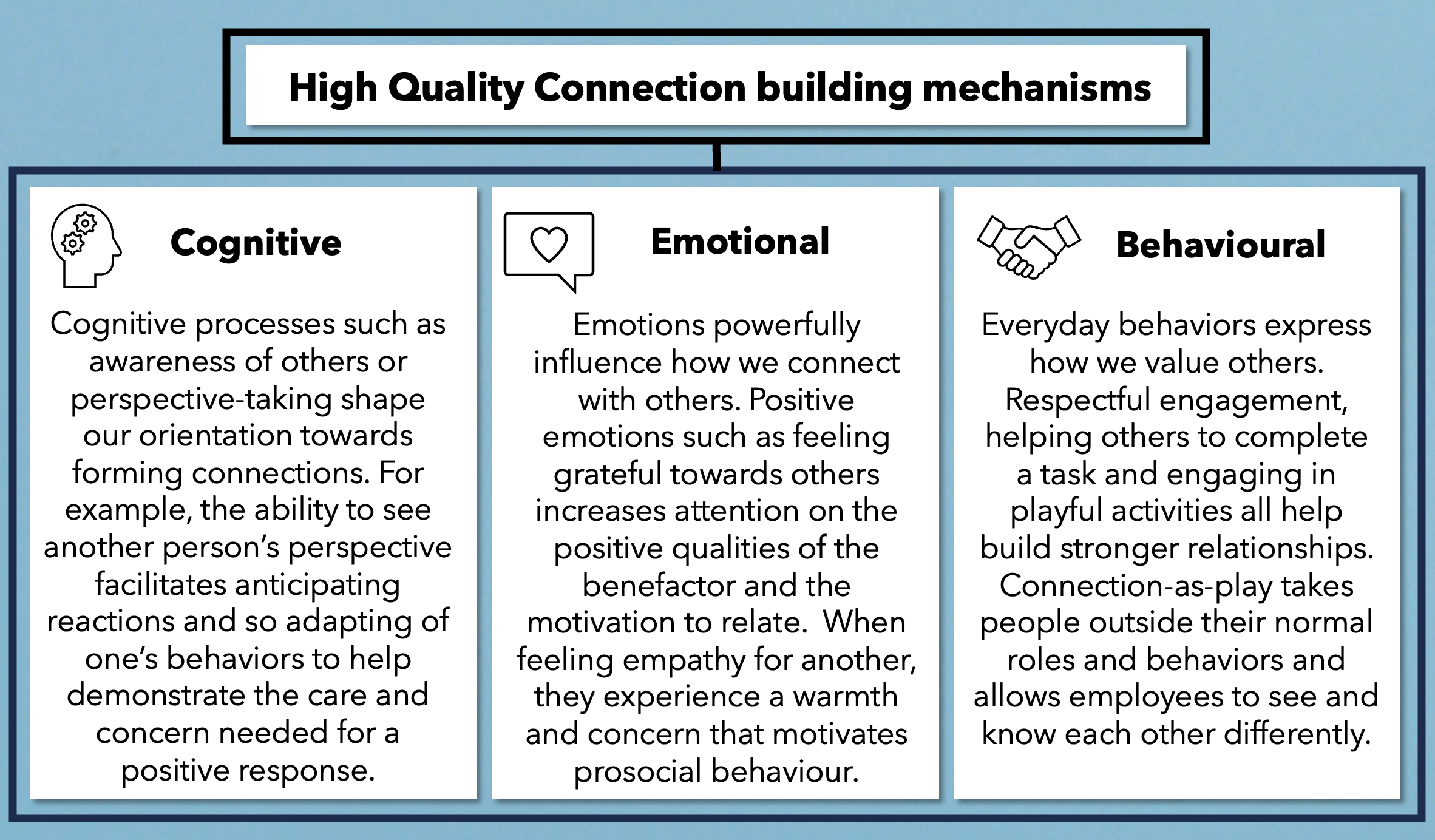
The brief summary above is sourced from Stephens JP, Heaphy E, Dutton JE. High-quality Connections. The Oxford Handbook of Positive Organisational Scholarship.
4. Meet your customers at the office. The potential for customer interaction to be the catalyst for a collective team experience is something to consider. The fact that research shows that shared experiences with different people strengthens social cohesion, and promotes prosocial behaviours means customer connection must not be limited to project driven research. Within workshops I have seen teams physically together beneficially connect to customers online. Short online interviews with consumers in multiple markets can energise discussion, build a shared sense of reality, and make it easier to revisit assumptions.
5. Talk about strengths, experience and interests together. The sharing of strengths and successes builds individual optimism and agency which may be a sufficient reason to set up a team discussion. Awareness of colleagues’ strengths and their interests will also build a collective sense of resources. If you are hesitating about a strengths sharing session consider how professional sport teams understand and utilise individual strengths and preferences. Extending the sport analogy, you can also collectively adjust job descriptions to increase the alignment of responsibilities or learning plans with strengths.

Shared experiences build cohesion and prosocial behaviours
In summary in-person activities should be taking connection, collaboration and cohesion to a higher level. It requires some extra attention and ambition.
 Facilitate Success