
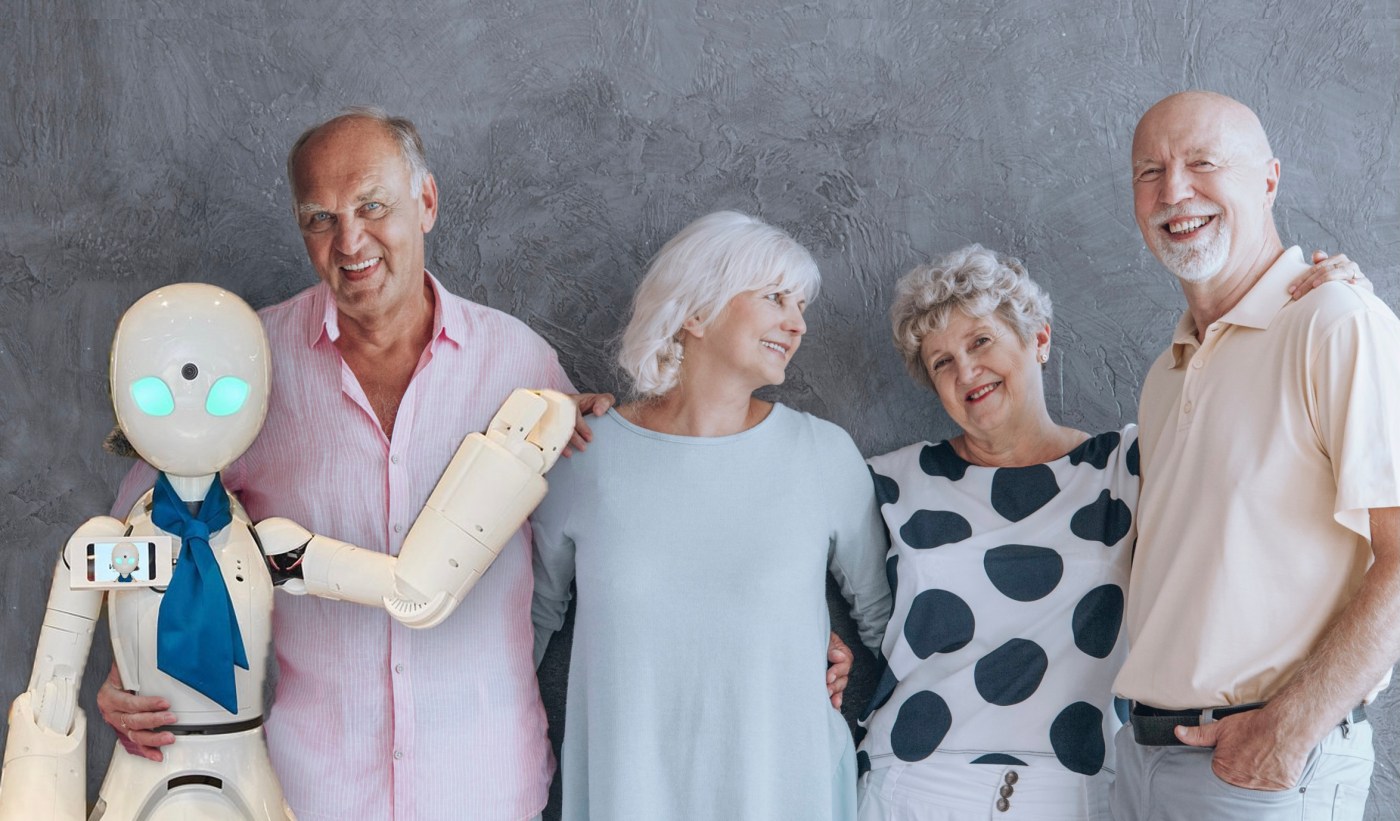
Robots want to help us stay connected.
The Dawn Café where customers mix with robot staff suggests future possibilities for social care. Each of the robots is a physical avatar controlled by a human via phone, tablet or eye-tracking device from their own home or even hospital.
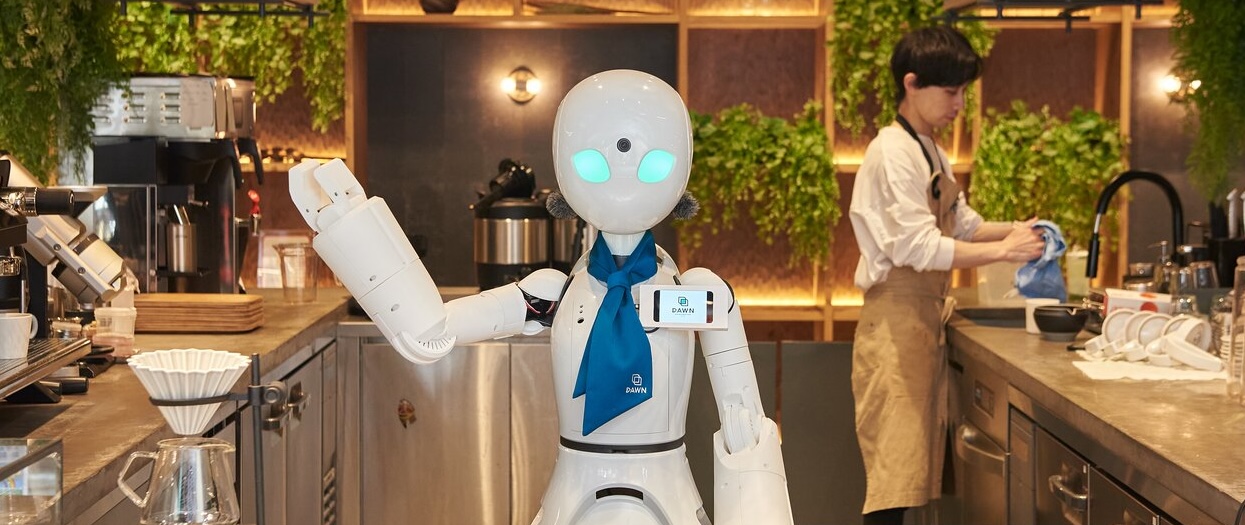
Creator Kentaro Yoshifuji explains his innovation as “teleportation.” Those losing mobility with age can mix with customers and other pilots sustain an active life and remain socially connected.
The Dawn Café is one example of Japan’s experimentation with socially assisting robots to help the elderly. It is no accident Japan is at the forefront of robotics – those aged 65+ will represent a third of the population by 2036. Japan’s declining social care labour force is already struggling.
Supporting social connection / participation for the elderly addresses a growing global issue. In the UK around a million adults aged 65+ often feel lonely. The mortality risk of social isolation and loneliness is comparable to smoking or obesity. Addressing it will reduce strain on health and social care systems – a better connected society supports individual happiness, cognitive ability, health and productivity.
But, robots struggle with loneliness too.
Unfortunately for those betting big on robots it is not good news. So far, robots help on loneliness and isolation for the elderly (and others) has been limited. There is evidence of robot interactions improving mood, reducing loneliness, supporting conversation therapy and decreasing stress. But, meta-analysis indicates the main mechanism of effect for reduced loneliness and increased positive affect is stimulating social interaction with other humans. Storytelling capabilities for engaging those with dementia looks encouraging, but the incremental benefit of delivery via robots rather than screen is questionable. The positive impact of pet-like robots also appears to be similar to plush toys offering no interaction. Whilst the potential for AI and Large Language Models to accelerate progress must not be overlooked, 20 years of effort has not found benefits that support scale adoption.

The furry, AI-powered Moflin aims to fill the emotional gap left by pets when owners can no longer care for them. How much of that gap is not clear.
Needed human capacity for connection can be found.
With a robot cavalry unlikely to arrive soon, the urgent challenge is finding more human capacity for social care and social connection in our communities. The good news is this possible through the ‘two dimensional’ application of AI and automation. Here’s three examples to illustrate the potential:
1. A step change in social care practitioner capacity?
Advancing technology will reduce time spent on low value tasks in many professions. This includes social care. For example, AI assistance (e.g. Microsoft Copilot) can reduce the 50% of a social worker’s time consumed by case recording, documentation, search and meetings. It can also enable the same workers to quickly shortlist personalised care options from a vast database. Given the struggle to retain these professionals the opportunity to increase their time to connect and collaborate directly with colleagues and those in need must be helpful.
2. More volunteers from a societal move to a four-day week?
The potential for technology to enhance productivity will accelerate momentum for a four-day week for more organisations. An extensive UK pilot has found retention increased and sick leave reduced. Most employees in the pilot found it easier to combine care responsibilities and research has indicated one in five professionals intend to use released time to volunteer. With a growing elderly population the opportunity to increase working population help can’t be overlooked.
3. Integrating virtual with human support to connect / sustain independence?
Digital inclusion ensures access to support networks, new relationships and awareness of local activities. It also opens up the potential for advancing technology to help keep someone happy in their home and community for much longer. Virtual care can be integrated with care worker visits, monitored changes can prompt virtual check-ins and online activities or groups can be offered.
With a week of residential care costing c£1,300 in the UK any investment in virtual connection for social support and activity looks compelling – even before increased care worker capacity is considered. Virtual interaction, however, can only be part of the answer. In-person connection is much more potent for establishing relationships and positive affect.
Virtual communication is fast improving. The avatar below was produced in 15 minutes.
Robots need to deliver significantly more or something distinct to fast progressing virtual communication / engagement.
Time to think about how we direct released human capacity?
We can be certain ‘new’ human capacity can be found. Technology will unlock time that can be reinvested in many roles including those in social care. It will also challenge the need for roles focused on admin, data-entry, routine queries, etc. With most companies that start a four-day week continuing we can aim for more working people volunteering. Use of virtual care will support greater care worker capacity.
The key question is can we orientate released capacity to support more social connection and participation for the elderly (and other cohorts) at risk of loneliness and isolation. Doing this would challenge the direction of travel for technology established over many decades. As Bowling Alone author Robert Putnam has observed, digital progress has contributed to individualised leisure time with use of social media on devices allowing “the illusion of connection without the demands of friendship and conversation.” (Consider what is expressed on social media relative to a conversation in-person where non-verbal cues and immediate consequences exist).
Leaders and policymakers in Health and Social Care must look beyond service productivity. Any target service model needs to reflect a higher valuation (and so share of resources) for in-person activities and ‘soft’ skills. The goal should be better coordinated services with significantly more capacity for in-person care, collaboration and social connection reaching our communities. Ambition, however, should extend to system and society to consider how we direct and enable capacity for social support and participation from the working age population. Mitigating the recent reduction in VCSE workforce and donations would be an early objective.
Some questions to address include:
- Where should released capacity for quality connection /care support be directed for most societal benefit?
- What does an ideal connected community destination look like and what does working back from this mean for public sector and VCSE contributions.
- How could additional voluntary capacity be empowered to promote and resource connection/prevention in communities to allow social / healthcare professionals to focus on more complex and acute needs?
- How could health and social care collaboration in our communities be improved with time released by technology, shared access to data and better organisation?
- How could digital connection be leveraged to stimulate in-person social participation at a community level?
Thinking strategically and boldly about where and how we direct ‘released’ connection capacity must make sense. Who is stepping up to shape a future service, system and community destination? Those developing technology including robots won’t be.
Many articles contributed to my learning. These were the key ones:
The Independent article that inspired my blog: https://www.independent.co.uk/asia/japan/tokyo-robot-cafe-dawn-japan-b2677817.html
Progress of the NAO robot: https://www.frontiersin.org/journals/robotics-and-ai/articles/10.3389/frobt.2021.744526/full
Socially assistive robots for people with dementia: https://www.sciencedirect.com/science/article/pii/S1568163722000757#sec0140
In person Vs virtual connection: https://www.sciencedirect.com/science/article/pii/S2451958824000885#:~:text=We%20observed%20no%20significant%20association,to%20predict%20positive%20affect%20significantly.
Neural Representations during Face Familiarization: https://www.jneurosci.org/content/41/26/5687
Example of copilot potential: https://www.local.gov.uk/case-studies/barnsley-council-pioneering-use-microsoft-copilot
Four day working week pilot: https://www.ukri.org/who-we-are/how-we-are-doing/research-outcomes-and-impact/esrc/making-the-case-for-a-four-day-working-week/
World Health organisation: https://www.who.int/activities/reducing-social-isolation-and-loneliness-among-older-people
 Facilitate Success